



Quo Vadis? (1913)
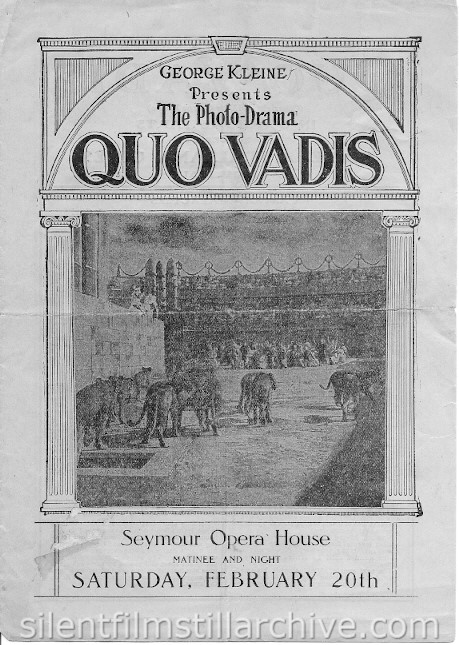
GEORGE KLEINE
presents The Photo-Drama
QUO VADIS
Seymour Opera House
Matinee and Night
SATURDAY,
FEBRUARY 20th (1915)
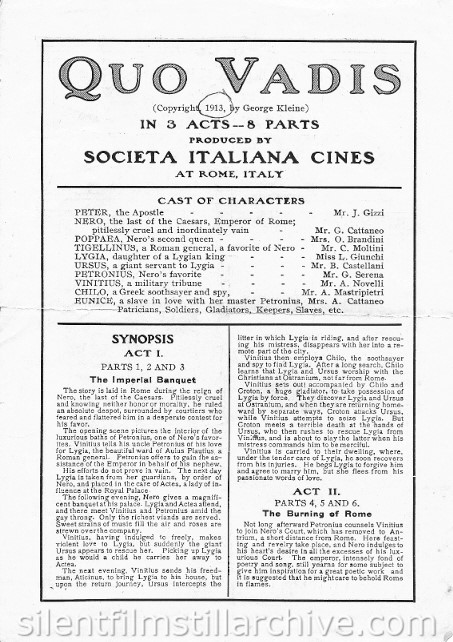
QUO VADIS
(Copyright 1913, by George Kleine)
IN 3 ACTS - 8 PARTS
Produced by
SOCIETA ITALIANA CINES
At ROME,
ITALY
CAST OF CHARACTERS
|
PETER, the Apostle |
Mr. J. Gizzi |
|
NERO, the last of the Caesars, Emperor of Rome; pitilessly cruel and inordinately vain |
Mr. G. Cattaneo |
|
POPPAEA, Nero's second queen |
Mrs. O. Brandini |
|
TIGELLINUS, a Roman general, a favorite of Nero |
Mr. C. Moltini |
|
LYGIA, daughter of a Lygian king |
Miss L. Guinchi |
|
URSUS, a giant servant to Lygia |
Mr. B. Castellani |
|
PETRONIUS, Nero's favorite |
Mr. G. Serena |
|
VINITIUS, a military tribune |
Mr. A. Novelli |
|
CHILO, a Greek soothsayer and spy, |
Mr. A. Mastripietri |
|
EUNICE, a slave in love with her master Petronius, |
Mrs. A. Cattaneo |
|
Patricians, Soldiers, Gladiators, keepers, Slaves, etc. |
SYNOPSIS
ACT 1.
PARTS 1, 2, AND 3
The Imperial Banquet
The story is laid in Rome during the reign of Nero, the last of the Caesars. Pitilessly cruel and knowing neither honor or morality, he ruled an absolute despot, surrounded by courtiers who feared and glittered him in a desperate contest for his favor.
The opening scene pictures the interior of the luxurious baths of Petronius, one of nero's favorites. Vinitius tells his uncle Petronius of his love for Lygia, the beautiful ward of Aulus Plautius, a Roman general. Petronius offers to gain fht (sic) assistance of the Emperor in behalf of his nephew.
His efforts do not prove in vain. The next day Lygia is taken from her guardians, by order of nero, and placed in the care of Actea, a lady of influence at the Royal Palace.
The following evening, Nero gives a magnificent banquet at his palace. Lygia and Actea attend, and there meet Vinitius and Petronius amid the gay throng. Only the richest viands are served. Sweet strains of music fill the air and roses are strewn over the company.
Vinitius, having indulged to (sic) freely, makes violent love to Lygia, but suddenly the giant Ursus appears to rescue her. Picking up Lygia as he would a child he carrier her away in Actea.
The next evening, Vinitius sends his freed-man, Aticinus, to bring Lygia to his house, but upon the return journey, Ursus intercepts the litter in which Lygia is riding, and after rescueing his mistress, disappears with her into a remote part of the city.
Vinitius then employs Chilo, the soothsayer and spy to find Lygia. Ater a long search, Chilo learns that Lygia and Ursus worship with the Christians at Ostranium, not far from Rome.
Vinitius sets out accompanied by Chilo and Croton, a huge gladiator, to take possession of Lygia by force. They discover Lygia and Ursus at ostranium, and when they are returning homeward by separate ways, Croton attacks Ursus, while Vinitius attempts to sieze Lygia. But Croton meets a terrible death at the hands of Ursis, who then rishes to rescue Lygia from Vinitius, and is about to slay the latter when his mistress commands him to be merciful.
Vinitius is carried to their dwelling, where, under the tender care of Lygia, he soon recovers from his injuries. He begs Lygia to forgive him and agree to marry him, but she flees from his passionate words of love.
ACT II
PARTS 4, 5 AND 6.
The Burning of
Rome
Not long afterward Petronius counsels Vinitius to join Nero's Court, which has removed to Antrium, a short distance from Rome. Here feasting and revelry take place, and Nero indulges to his heart's desire in all the excesses of his luxurious Court. The emperor, intensely found of poetry and song, still yearns for some subject to give him inspiration for a great poetic work and it is suggested that he might care to behold Rome in flames.
And it is not long afterwards that a messenger enters Nero's presence with the words "Rome is burning."
The whole city is now seen a mass of flames, It flows like a great furnace, and illuminates the sky for miles around. Thousands of unfortunate people perish, and others rush through the crowded streets, in a frantic struggle for safety.
When the flames are finally extinguished the Roman people, reduced to great want, cry loudly for revenge. Many angrily accuse Nero himself of the crime. Greatly alarmed, the Emperor gladly embraces the suggestion of the false Chilo, seconded by Tigellinus, that the Christians are the real culprits and a general arrest of them takes place, among them Lygia and Ursus.
ACT III.
PARTS 7 AND 8
The Christian Martyrs
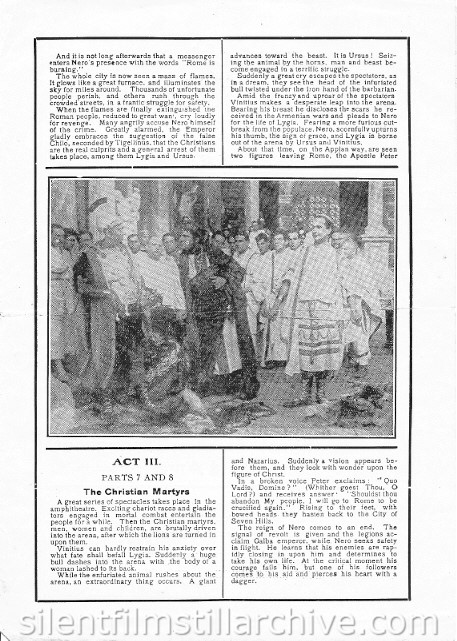
A great series of spectacles takes place in the amphitheatre. Exciting chariot races and gladiators engages in mortal combat entertain the people for a while. Then the Christian martyrs, men, women and children, are brutally driven into the arena, after which the lions are turned in upon them.
Vinitius can hardly restrain his anxiety over what fate shall befall Lygia. Suddenly a huge bull dashes into the arena with the body of a woman lashed to its back.
While the enfuriated (sic) animal rushes about the arena, an extraordinary thing occurs. A giant advances toward the beast. It is Ursus! Seizing the animal by the horns, man and beast become engages in a terrific struggle.
Suddenly a great cry escapes the spectators, as in a dream, they see the head of the infuriated bull twisted under the iron hand of the barbarian.
Amid the renzy and uproar of the spectators Vinitius makes a desperate leap into the arena. Bearing his breast he discloses the scars he received in the Armenian wars and pleads to nero for the life of Lygia. Fearing a more furious outbreak from the populace, Nero scornfully upturns his thumb, the sign of grace, and Lygia is borne out of the arena by Ursus and Vinitius.
About that time, on the Appian way, are seen two figures leaving Rome, the Apostle Peter and Nazarius. Suddenly a vision appears before them, and they look with wonder upon the figure of Christ.
In a broken voice Peter exclaims: "Quo Vadis, Domine?" (Whither goest Thou, O Lord?) and receives answer "Shouldst thou abandon My people, I will go to Rome to be crucified again." Rising to their feet, with bowed heads they hasten back to the City of the Seven Hills.
The reign of Nero comes to an end. The signalof revolt is given and the legions acclaim Galba emperor, while Nero seeks safety in flight. He learns that his enemies are rapidly closingin upon him and determines to take his own life. At the critical moment his courage fails him, but one of his followers comes to his aid and pierces his heart with a dagger.
Marvelous Kleine-Cines Photo Drama
Quo Vadis
IN 3 ACTS - 8 PARTS
Performance Lasting 2 1-4 Hours
As Presented at
Astor Theatre, New York
(306 Consecutive Performances)
McVicker's Theatre, Chicago
(112 Consecutive
Performances)
And at first-class theatres in all the principal cities of the United States
A FEW OF THE PRESS COMMENTS
"Superbly shown at the Astor - "QUO VADIS"
superior to play." - New York Sun
"Terrifying and inspiring
- exquisitely religious - stupendous." - Chicago News.
"Of
superlative merit - thrilling and spectacular." - Philadelphia Ledger
"Exciting
- holds the audience spellbound." - Baltimore American
"The
photo-play created a tremendous impression on the Broadway audience."
- Brooklyn Times.
"Thrilling scenes reproduced with wonderful realism
at Tremont." - Boston Globe
A Sensational Success Throughout Europe and America
Mr. George Kleine
Sole Proprietor for United
States and Canada
General Offices, 166 N. State Street
CHICAGO
Eastern Offices 1476 Broadway
NEW YORK
EXECUTIVE STAFF FOR MR. KLEINE
General manager F. C. McCARAHAN
Eastern Representative
W. E. RAYNOR
Press Representative ARTHUR F. WARDE
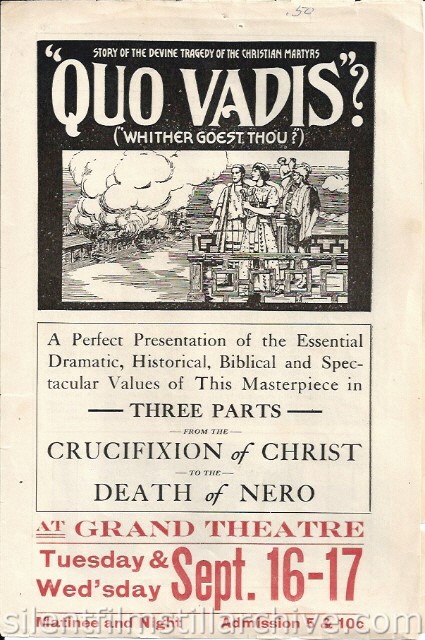
STORY OF THE DEVINE TRAGEDY OF THE CHRISTIAN MARTYRS
"QUO VADIS?"
("WHITHER GOEST
THOU?"
A Perfect Presentation of the Essential Dramatic, Historical, Biblical and Spectacular Values of This Masterpiece in
--- THREE PARTS ---
--- FROM THE ---
CRUCIFIXION of CHRIST
--- TO THE
---
DEATH OF NERO
At GRAND THEATRE
Tuesday & Wed'sday Sept. 16-17
(1913)
Matinee and Night Admission 5 & 10c
Presented by the QUO VADIS FILM COMPANY, Inc.
"QUO
VADIS?"
("Whither Goest Thou?")
In Three Reels and Three Parts and Over 150 Stupendous Scenes
PROLOGUE -- A.D. 33. AFTER THE CRUCIFIXION OF
CHRIST
PRINCIPAL CHARACTERS
SAUL (hebrew for Paul) an enemy of the Christians, but
later a disciple of Christ
STEPHEN, the first Christian martyr
ANANIAS,
a disciple of Christ
HEROD AGRIPPA, King of the Roman provinces in Palestine
31 YEARS LATER -- A.D. 64
PRINCIPAL CHARACTERS
|
PAUL |
One of Christ's Apostles |
|
NERO |
Emperor of Rome |
|
LYDIA |
A Hostage to Rome |
|
POPPAEA |
Nero's Second Wife |
|
PETRONIUS |
Neros Friend and Favorite |
|
TIGELLINUS |
A Roman General |
"QUO VADIS?"
THE STORY OF THE CHRISTIAN
MARTYRS
DO you know the story of Christianity -- the light of the world? You do. There are few who do not.
Even those who deny it know of it. They must or they could not deny it. They know of the child born in the manger, of the life, persecution and death of Jesus of Nazareth.
The new testament is the greatest book that has ever been written. to speak in everyday terms, it is the world's best seller.
But it is all bout the events leading up to, including the immediately following the crucifixion.
And the most tragic, heart-rending, inspiring story comes after that. It is the story of the divine tragedy of the Christian martyrs; men, women and little children, who gave up their lives, were killed, tortured, their bodies dismembered, thrown living into vats of molten lead, burned on crosses, beaten to death; all that the civilization of today might have the leavening influence of Christianity.
Do you know that story? It is written with the blood of these martys (sic) on the imperishable pages of human memory. it needs no historian. it is immortal.
So its reproduction, not in words, not in epic verse, not in inadequate paintings, but in graphic, realistic, thrilling, blood-stirring pictures; pic-
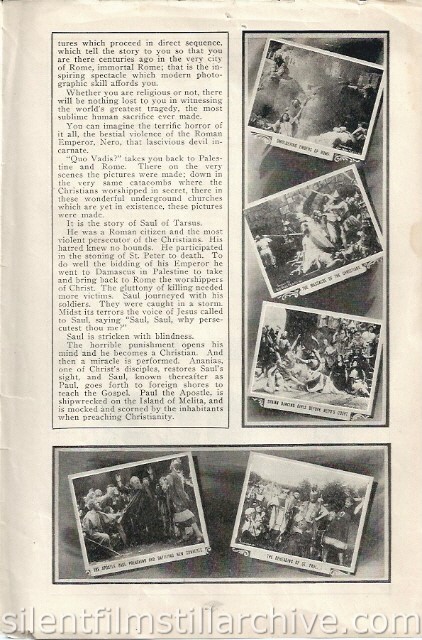
THE ARENA
tures which proceed in direct sequence, which tell the story to you so that you are there centuries ago in the very city of Rome, immortal Rome; that is the inspiring spectacle which modern photographic skill affords you.
Whether you are religious or not, there will be nothing lost to you in witnessing the world's greatest tragedy, the most sublime human sacrifice ever made.
you can imagine the terrific horror of it all, the bestial violence of the Roman Emperor, nero, that lascivious devil incarnate.
"Quo Vadis?" takes you back to Palestine and Rome. There on the very scenes the pictures were made; down in the very same catacombs where the Christians worshipped in secret, there in these wonderful underground churches which are yet in existence, these pictures were made.
It is the story of Saul of Tarsus.
He was a Roman citizen and the most violent persecutor of the Christians. his hatred knew no bounds. he participated in the stoning of St. Peter to death. to do well the bidding of his Emperor he went to Damascus in Palestine to take band bring back to Rome the worshippers of Christ. the gluttony of killing needed more victims. Saul journeyed with his soldiers. There were caught in a story. Midst its terrors the voice of Jesus called to Saul, saying "Saul, Saul, why persecutest thou me?"
Saul is stricken with blindness.
The horrible punishment opens his mind and he becomes a Christian. and then a miracle is performed. Annanias, one of Christ's disciples, restores Saul's sight, and Saul, known thereafter as Paul, goes forth to foreign shores to teach the Gospel. Paul the Apostle, is shipwrecked on the Island of Melita, and is mocked and scorned by the inhabitants when preaching Christianity.
SMOULDERING EMBERS OF ROME.
THE MASSACRE OF THE CHRISTIANS.
SYRIAN DANCING GIRLS BEFORE NERO'S COURT
THE APOSTLE PAUL PREACHING AND
BAPTIZING NEW CONVERTS
THE BEHEADING OF ST. PAUL
And Rome, horrible Rome, under Nero, under Nero, continues her persecutions. Unabated is the hatred of Nero and the Romans. Then the Kind of Lygia sends his daughter Lygia to nero as a hostage. Her great beauty wins the Emperor. He commands festivities in her honor. They travel in the royal barge on the Tiber to the Island of the Vestial Virgins.
Poppaea, the Empress, remains at home. She loves the noble Petronius and tries during the Emperor's absence to enslave him. But the aristocratic petronius is already enslaved by his beautiful former slave, who adores him. And he is Nero's friend, one of the few true friends of the brutal rule of the Romans.
And Paul goes to this Rome of debauchery, lust and brutality. He preaches and converts and baptizes.
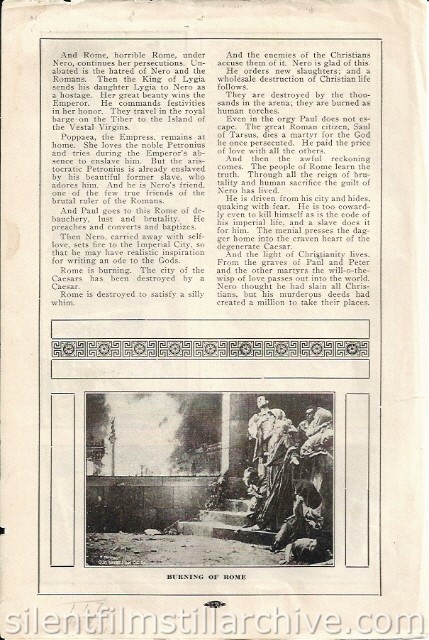
Then Nero, carried away with self-love, sets fire to the Imperial city, so that he may have realistic inspiration for writing an ode to the Gods.
Rome is burning. The city of the Caesars has been destroyed by a Caesar.
Rome is destroyed to satisfy a silly whim.
And the enemies of the Christians accuse them of it. Nero is glad of this.
He orders new slaughters; and a wholesale destruction of Christian life follows.
They are destroyed by the thousands in the arena; they are burned as human torches.
Even in the orgy Paul does not escape. The great roman citizen, Saul of Tarsus, dies a martyr for the God he once persecuted. He paid the price of love with all the others.
And then the awful reckoning comes. The people of Rome learn the truth. Through all the reign of brutality and human scrifice the guilt of Nero has lived.
He is driven from his city and hides, quaking with fear. He is too cowardly even to kill himself as is the code of his imperial life, and a slave does it for him. The menial presses the dagger home into the craven heart of the degenerate Caesar.
And the light of Christianity lives. From the graves of Paul and Peter and the other martyrs the will-o-the-wisp of live passes out into the world. nero thought he had slain all Christians, but his murderous deeds had created a million to take their places.
BURNING OF ROME
with Amoleto Novelli and Gustavo Serena. Directed by Enrico Guazzoni. Cines Italy/Kleine.
More Information on this film...






This work (Quo Vadis (1913), by
Cines
/ George Kleine), identified by
Bruce Calvert, is free of known copyright
restrictions.
Books
none.
Last Modified November 10, 2015